
Trust the Footwasher
A homily for Maundy Thursday

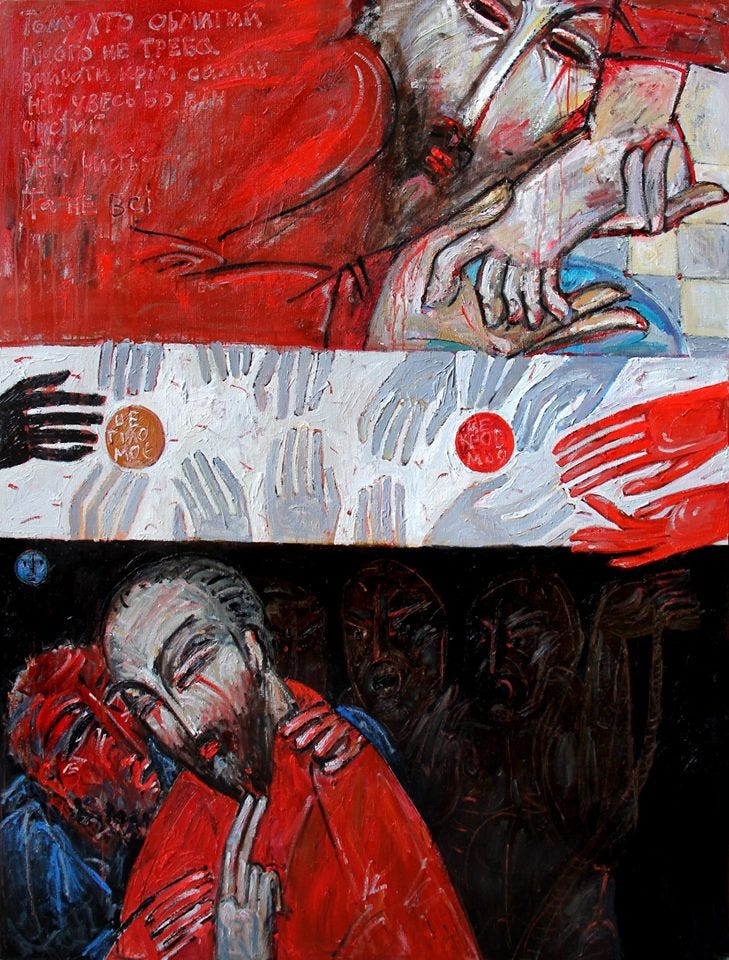
“Lord, do you wash my feet?”
St. Peter can’t believe his eyes. His words ring with disbelief, incredulity, and maybe a hint of disappointment. What on earth is Jesus doing? The disciples—and everyone else in town—need a hero. They need someone to end hundreds of years of Roman oppression, to wash the streets of occupiers, not wash the grimy feet of fishermen in a rented room. Jesus keeps refusing to take over. He won’t assert himself as the leader of the revolution. He makes vague statements about a Kingdom, but then doesn’t pick up a sword and make business decisions. Now, he’s tied a towel around his waist and is rinsing filth. Worst. Messiah. Ever.
Jesus descends. That’s what he does.
Have this mind among yourselves, which is yours in Christ Jesus, who, though he was in the form of God, did not count equality with God a thing to be grasped, but emptied himself, by taking the form of a servant, being born in the likeness of men. And being found in human form, he humbled himself by becoming obedient to the point of death, even death on a cross.
Philippians 2:5-8
In the Garden, the snake promises Eve he can make her ‘like God,’ as if being like God was something possible. She could be like God, without any need for listening to God. Without anyone telling her how to act, what to do. She could be fully actualized, empowered, and the captain of her fate. Just cut out the middle man, Eve, grab this fruit for you and your husband, and get the life you’ve always wanted. Get the life you deserve. Stop washing feet, Jesus! That’s a servant’s work, get up and take charge!
He emptied himself. Jesus set aside what is rightfully his to walk dirty roads and serve dinner to people who would sell him out for thirty pieces of silver. No servant was in the room to wash their feet that night, so God did it. You might read about “servant'-leadership” in management books, you might think this is a great example to boost productivity at your workplace—let them see the boss do the dirty work. Don’t. This misses the point entirely. Jesus isn’t giving us an example of how to lead from the back; he isn’t showing us the best way to make our business successful. Jesus is showing us what it looks like to love someone to the end. Jesus is showing us the Gospel through action. He lowers himself. The one clean One washes us because we can’t wash ourselves. To prepare for the Passover feast, the lamb the whole shooting match is all about doesn’t take the place of prominence, but finds one more place to stoop lower. While we compete for accolades and money and power, the Almighty One exposes the joke. We are like kids celebrating a win in a T-ball game that didn’t keep score.
This messiah that refuses to take the crown will eventually find new depths to plumb. He will be betrayed by one of his best friends, sold out by the leaders of his religion, and executed on false charges. The crowds that showered him with praise will turn on him, finding him inadequate, and demand that he be strung up. The depth of death won’t be enough; he will descend even further. There are still sinners to be found. The God of the universe will descend to hell.
The best laid plans of people in power, the politics and justice programs of the day, are proven to be shams as they find the one innocent man guilty. The comedian Pete Holmes once described cigarettes as “three inches of no one tells me what to do.” The cross shows that so much of our systems, so much of our life, so much of the things we do to make ourselves feel in control are just three inches of no one tells me what to do. We crave autonomy, we crave control, we need to know someone is in charge—and we’d prefer it to be us. We want to make ‘the best decision for our family,’ but what we really mean is we want to curate every aspect of our lives, because we don’t trust anyone or anything.
We definitely don’t trust a footwasher. What’s his angle? We trust a guy with a sword, we trust a king on a horse, but a servant on a donkey gives us pause. We’ll build statues to kings on horses, generals holding swords get streets named after them, and as much as we Americans claim to hate a king—we do love a man in charge.
Maundy Thursday, if it does anything, asks the one question that Jesus continues to ask us: do you trust me? Do you trust this footwasher? Do you trust the poor rabbi hiding out in a rented room serving bread and wine to his friends? Do you trust the servant on a donkey even though you probably would rather him be a king on a horse?
We look for salvation from so many places. We think if we just work harder, control, maximize, achieve, scratch and claw then we can somehow guarantee good things happen to us—we can buy our salvation. We think if we just got the right strongman in charge then we will be safe and secure, so we look to Washington, or we look to the C-suite, or we look inward, meanwhile God is on his knees washing our feet. We seek after money and titles, look for the perfect house in the perfect neighborhood, try to impress people we don’t even like, when the Savior we betray still offers us His Body and Blood.
Maundy Thursday asks us if we trust Him, Jesus reminds us he loves us anyway. He loves Peter, who is going to deny him in just a few hours, and still doesn’t understand what’s going on. He loves this rabble of fishermen and tax collectors and he loves our church full of lawyers and nurses and businessmen. He loves each of us to the end. He takes his outer garment and sets it aside in each of our lives because there is work to be done on our feet. There’s grime and muck we can’t wash off ourselves.
“Lord, do you wash my feet?”
He does. Even though you’re going to betray him with a kiss. Even if you’re going to deny him—scared of some little girl by a campfire. Even if you still really wish he’d pick up a sword instead of a towel. Jesus descends. He goes down on the ground and does the dirty work. He knows you don’t really know what you need. He is patient with sinners destined to return to dust.
In our liturgy, we strip the altar on Maundy Thursday. We take communion together one last time and then we take all the trappings of resurrection and hide them away. We prepare for crucifixion, because as degrading as washing feet is, there is still worse Jesus has to do. Some stains don’t wash out with water and a towel. This service is a powerful reminder of our need for a savior, and the overwhelming beauty of the one we have.
May we learn to trust this footwasher, and rest in the knowledge that he would do anything and go anywhere to be with us.
Amen 🙏